After posting the preliminary exercise 4 days ago we have had time to evaluate it, and consider what went well and what we did wrong. Firstly from this exercise I learnt how to properly use the shot/ reverse shot, and looking at the film I saw that I almost broke the 180 rule, which means when I film our final film I will know how to film the shot to make sure I do not break the rule, the way I will achieve this is by making sure that if my actors our on the right side of the screen, they need to ne looking across to the actor on the left side of the camera.
Match on action is another shot which is used in the film. In our preliminary film, the shot with the door displays our match on action, as the shot smoothly shifts from a shot of our actor approaching the door, to a close up of our actor opening the door handle. This shot was executed well and this reflects in our film, as the transition between shots are smooth.
The shot/reverse shot was another shot which was required in our 30 second film. This shot was also executed very well, as the shot was clearly identifiable when the conversation switches between the two actors in the shot, which shows the conversation from both character's perspective. A very minor improvement that could be made is the steadiness of the camera, as in our film, there are slight glitches where the camera has moved slightly which could be addressed with a steadier hand.
- Quinn
Wednesday, 13 November 2013

Friday, 8 November 2013
Preliminary Exercise - 30 Second Movie
-Quinn and Jak
Saturday, 26 October 2013
Synopsis of Film Introduction ( UPDATED)
The film starts by fading from black and the first thing visible is a person arriving at the location on a motorcycle, you can't see the persons face, an intriguing aspect as the character remains unknown. The camera then proceeds to film the character coming to halt and subsequently removing his helmet, however his face is still not revealed to further increase the growing tension of the opening.
Once the character his removed his helmet, the camera then follows him as he approaches the garage door, in conjunction with this, the underlying music continues to build up slowly to enhance the tension within the scene by slowly gaining pace to increase the suspense. A close up of the character reaching the handle and then opening the garage is shown. After this shot, there is an extreme close up of the characters eyes to show how he is looking around the area to ensure he hasn't been followed or to see if anything in the garage is of interest.
The character then reaches for an envelope which contains blueprints of a building. The character subsequently grabs a pen and circles the area of interest, which fuels speculation from the audience as to what's going on at the precise point in the sequence.
After this close up, the camera focuses on a laptop on a table, and the character comes into the shot rather than the camera following the character, this is to emphasise the importance of the laptop. The character then sits down at the table and opens the laptop up, and reveals a message on the screen stating that a download is complete, the characters face still isn't visible so the identity of the character or his motives remain untold, which keeps the audience intrigued and wanting to continue watching.
Then the character looks around the garage and finds a large tool and lifts it up to test its weight. Once again, the characters face remains hidden to conceal his identity throughout the sequence. After putting the object down, the character subsequently walks towards the garage exit, while remaining very close to the camera to portray the mood in the scene.
The character then pens the garage, followed by the camera he then puts on his helmet, starts his motorcycle, then proceeds to ride away, the sequence ends at this point.
- Jak
Once the character his removed his helmet, the camera then follows him as he approaches the garage door, in conjunction with this, the underlying music continues to build up slowly to enhance the tension within the scene by slowly gaining pace to increase the suspense. A close up of the character reaching the handle and then opening the garage is shown. After this shot, there is an extreme close up of the characters eyes to show how he is looking around the area to ensure he hasn't been followed or to see if anything in the garage is of interest.
The character then reaches for an envelope which contains blueprints of a building. The character subsequently grabs a pen and circles the area of interest, which fuels speculation from the audience as to what's going on at the precise point in the sequence.
After this close up, the camera focuses on a laptop on a table, and the character comes into the shot rather than the camera following the character, this is to emphasise the importance of the laptop. The character then sits down at the table and opens the laptop up, and reveals a message on the screen stating that a download is complete, the characters face still isn't visible so the identity of the character or his motives remain untold, which keeps the audience intrigued and wanting to continue watching.
Then the character looks around the garage and finds a large tool and lifts it up to test its weight. Once again, the characters face remains hidden to conceal his identity throughout the sequence. After putting the object down, the character subsequently walks towards the garage exit, while remaining very close to the camera to portray the mood in the scene.
The character then pens the garage, followed by the camera he then puts on his helmet, starts his motorcycle, then proceeds to ride away, the sequence ends at this point.
- Jak
Tuesday, 22 October 2013
Snatch,Skyfall and Star Trek introduction analysis-Quinn

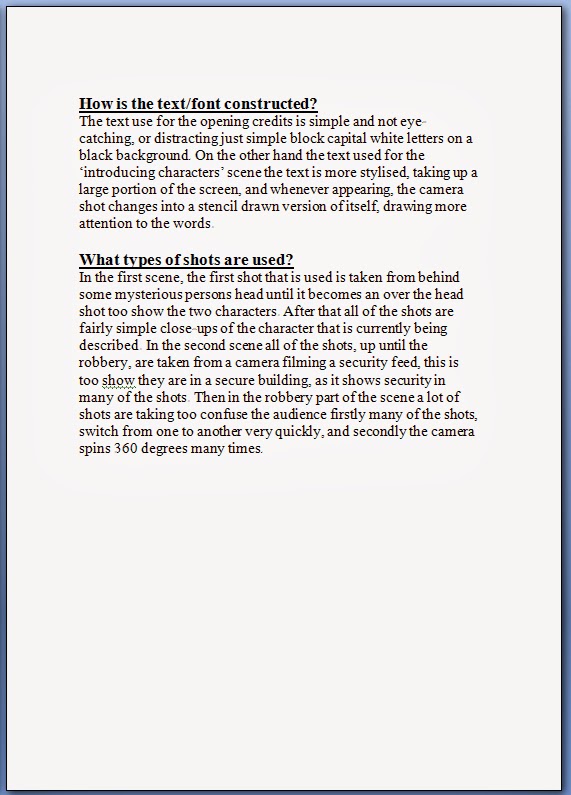


Wednesday, 16 October 2013
Analysis of film openings - Jak
Because I couldn't upload the file, I have copied the homework instead of uploading the file
In the
opening, the mood is set straight away, with the sound used, and the colours
involved. When watching the opening of
The Terminator, the audience can instantly have the assumption that the mood is
an eerie, dark one. This is because the film is dark, not in terms of the
content i.e. dark humour, but the actual colours themselves. The opening scene
is set at night, because it’s dark, with a large aircraft patrolling an area
which appears to have been decimated in some way, with absolutely no sign of
life. The audience can assume that the aircraft has done this, because lasers
are fired from the aircraft during the scene, but the fact that the scenery has
been completely destroyed suggests that the mood within the film is certainly
going to be a dark, downbeat one, however it is also eerie, because of how the
sound corresponds to the mood and atmosphere from the pictures. The dark, quiet
and low pitch tune in the background further emphasises the eerie mood, because
the tune is monotonous, it rarely changes pitch or volume, which could be
argued portrays quite a dull or boring mood, because of the repetitiveness.
The sound in Skyfall is used in a manner which creates tension, and also builds up the action packed content that is on the screen. The sound is quite upbeat, and is progressive, it build up in stages which promotes the feeling of tension throughout the opening sequence. This is effective in an action film, because you want your target audience to be excited and intrigued by the opening, as it makes them want to continue watching the remainder of the film, to see how the mood and atmosphere develops throughout the rest of the film.
In the openings, close range shots are used brilliantly. A close up of a man’s slightly bloodied face and bloodshot eyes, widely depicts horror or terror within the film, something which is prevalent in the film.
Film
Openings Jak Edgley
The first
film opening I have decided to look at is The Terminator (1984). In the opening
of this film, the characters aren’t introduced immediately by showing their
faces, where you could put a face to the character before the film has started.
Instead of this, James Cameron decides to display the characters names, and the
actors who play them, after a tense, yet eerie three minute opening. This is a
useful way to appeal to your target audience, because if James Cameron was
targeting an audience who like to be engrossed by a film, then he has achieved
this, because by not immediately revealing the identity of the characters, it
creates a sense of intrigue, which subsequently engages the audience and almost
forces them to pay attention to what’s happening.
By engaging
the audience early, Cameron has immediately succeeded in targeting his
audience, which will result in the target audience interpreting the film the
way he wants them to, because he has specifically catered to their interests by
creating the opening in this way, the intended audience.
How is the mood
set?
How is sound used?
The sound in
this opening has been used effectively to accommodate the atmosphere and mood
within the film itself. As briefly stated above, a dark, low pitch tune is
constant throughout the opening, creating a very real sense of tension, which
captivates the audience immediately, because it has caught their interest,
something James Cameron would have thought of when targeting his audience.
Also, the sound of the laser being fired during the opening is also
particularly effective, because it immediately implies that the film is not a
realistic one, it is in fact fictional or extravagant; this again shows how
James Cameron has specifically targeted his audiences by including these little
details, which have a lasting effect on the film, and the audience who watch
it.
How is the text constructed?
The text is
constructed to stand out and be noticeable. The main text of the openings, such
as the actors names and the characters they play, are bold and in white. The
text is accompanied by a moving blue background, which is extremely effective,
because it brings the text to life, it stands out significantly more than if
the background had not of been moving. The text shows a resemblance to a
computer in the way it appears. It appears with a large flashing square to the
left of the text, which can suggest that the film is quite futuristic, or
intended to be technologically advanced.
The Style
The opening
of the film tends to use a variety of long shots and close ups in the opening
few minutes, this shows that the film is concealing information from the
audience at the start, because of the effect it shows, by keeping the action at
a reasonable distance. The mise-en-scene is very dark; therefore you can’t see
a lot of the surroundings, which creates a sense of eeriness.
Skyfall
In the
opening of Skyfall, the character names are introduced immediately, by the
opening title sequence. The opening is only limited to images of the main
character, James Bond himself. This shows that the film has deliberately done
this, because they want to focus solely on the main character, and not wander
off to less significant characters throughout the film. The action packed
opening, nearly 4 minutes in length, focuses solely on Bond, and his potential
troubles in the film. The target audience is an audience looking for an action
film, which focuses on the main character throughout the film , usually an
heroic, macho character who eventually ends up saving the day.
Mood
The mood is
set instantly. Throughout the opening, the scenes change rapidly, with action
and tension progressively building up, accompanied expertly by the background
music, which progressively gets livelier as the scenes continue. This is an
effective method to create mood, because the way in which the scenes change so
quickly, clearly indicates that a lot will be happening in this film, which
instantly thinks the audience to lean towards the prospect of an action film,
which is this case, is accurate. The target audience has been sighted as one
that enjoys action films, while following the stories and/or adventures from
the main character in the film.
Sound
The sound in Skyfall is used in a manner which creates tension, and also builds up the action packed content that is on the screen. The sound is quite upbeat, and is progressive, it build up in stages which promotes the feeling of tension throughout the opening sequence. This is effective in an action film, because you want your target audience to be excited and intrigued by the opening, as it makes them want to continue watching the remainder of the film, to see how the mood and atmosphere develops throughout the rest of the film.
How text is constructed
The written
text is predominantly located at the bottom of the screen, which is an ideal
place to put it, because in conjunction with the moving text, the titles set up a lot of the events and
images that appear later in the film, instilling a sense of déjà vu in the
viewers mind, which is effective, because the audience will remember this, and
will refer back to it when the film ends. The moving text is varied; sometimes
it’s very bright and fiery, when on some occasions the moving text can be very
dark, both ways display a different meaning which the audience will pick up on.
The fiery feeling will make the audience think that either the character on
screen is fired up to do something, or the mood in general is a hostile one,
based on what may of happened previously. This is a huge contrast to the dark
text, where this gives the impression that the mood at this specific time is a
negative one, or a sad one, as the dark colours depict anger and anguish.
Style
The opening
uses a variety of camera shots/angles which can depict many different feelings
or emotions within the text. There are numerous close range shots, which indicates
that the attention is solely based on one particular person or item in any
given scene, which is effective as it could identify a character of interest to
the audience, which they may pick up on. The mid shots are less effective;
however, they usually include more than one character in these shots; which
shows that there may be a sense of togetherness within a certain scene.
Right at the
start, in the title sequences, the mise-en-scene includes things such as
vicious, fiery dragons, which in turn creates a sense of danger, as the colours
red and orange signify danger. Also the fonts used are basic, but are useful,
because the whiteness of the text stands out in front of all of the bright
colours, which makes the text easier to identify and read.
The Incredible Hulk (2008)
In the
opening of this film, the characters aren’t introduced by dialogue, they are
introduced through the use of written text, which is a smart method, because it
just states who the characters are, the audience will have to wait until
further in the film to decide which characters have certain personalities. The
target audience for this would be people who obviously enjoy Marvel films; but
also people who enjoy an action film, with an unrealistic plot, almost science
fiction esque.
Mood
The mood is
instantly set through the use of dark images, which portray a sense of danger,
which could coincidentally make the mood a negative one, because of the danger
depicted in the opening. This is a good way of immediately showing the mood,
because the audience will instantly get a perspective of the potential plot of
the film, and the way on which characters subsequently react to the mood. Also
the scary music adds to the mood of the film a little bit too. The way in which
the music drones in a low pitch, shows how the mood is a negative one,
something the audience can pick up on, even without watching any of the film or
its predecessors.
Construction of text
The written
text is green, which is good, as it depicts the colour of the main character,
which of course is green. The moving
text however is a variety of colours, ranging from black, to red, green and
orange. The use of these colours is fairly significant because each individual
colour sends a message to the audience about the atmosphere in a particular
scene. Orange for example shows danger and alertness, whereas green is a nasty
colour, associated with sickness and illness.
Style
In the openings, close range shots are used brilliantly. A close up of a man’s slightly bloodied face and bloodshot eyes, widely depicts horror or terror within the film, something which is prevalent in the film.
The
mise-en-scene is also used well. The backgrounds are bright, or dark which each
show a different style of atmosphere within the film , such as danger or
horror.
Moodboard images


Here are a couple of images which show the creation process of our mood board - Jak
Friday, 4 October 2013
Transcript of conversation for ideas of film.
Jak: So, what should our film be like?
Quinn: I think we should do an action film.
Jak: Why's that?
Quinn: The content will be more interesting, and it would be fun to produce.
Jak: I agree, it would be very interesting to produce, in that case, what should our film be about?
Quinn: I'm not sure, how about we have our characters trapped on a desert island?
Jak: No we can't do that, it would not be practical to produce, we don't have the equipment to pull this off.
Quinn: Ok, fair enough, what do you think we should do?
Jak: Something more practical, how about a bank heist?
Quinn: That sounds like a good idea, but how would we film this?
Jak: How about for the start of a sequence, we have a character in a makeshift prison, reflecting on his life, and then the scene skips to the character, in a mask, outside Barclays Bank?
Quinn: Yes, that sounds perfect, we should go ahead with that!
Quinn: I had this idea earlier, but was unsure whether it would work.
Jak: It will definitely work, it was a fantastic idea, it will work brilliantly.
Quinn: What music should we include in our title sequence?
Jak: I'm not sure, what do you think?
Quinn: I think we should use some soft, reflective music at the start for when the main character reflects on his life, then the music should speed up and become more dramatic, then it suddenly stops, with the character outside of the bank, in a mask.
Jak: Sounds brilliant, but how will we create the music?
Quinn: I know someone who could assist us in that.
Jak: Who's that?
Quinn: Jack Moore is very good at music and would be willing to help us.
Jak: That will be great, we will ask him then.
Quinn: Is there anything else we need to discuss?
Jak: I think that's everytthing for now, we will discuss more ideas as we think of them.
-Jak
Quinn: I think we should do an action film.
Jak: Why's that?
Quinn: The content will be more interesting, and it would be fun to produce.
Jak: I agree, it would be very interesting to produce, in that case, what should our film be about?
Quinn: I'm not sure, how about we have our characters trapped on a desert island?
Jak: No we can't do that, it would not be practical to produce, we don't have the equipment to pull this off.
Quinn: Ok, fair enough, what do you think we should do?
Jak: Something more practical, how about a bank heist?
Quinn: That sounds like a good idea, but how would we film this?
Jak: How about for the start of a sequence, we have a character in a makeshift prison, reflecting on his life, and then the scene skips to the character, in a mask, outside Barclays Bank?
Quinn: Yes, that sounds perfect, we should go ahead with that!
Quinn: I had this idea earlier, but was unsure whether it would work.
Jak: It will definitely work, it was a fantastic idea, it will work brilliantly.
Quinn: What music should we include in our title sequence?
Jak: I'm not sure, what do you think?
Quinn: I think we should use some soft, reflective music at the start for when the main character reflects on his life, then the music should speed up and become more dramatic, then it suddenly stops, with the character outside of the bank, in a mask.
Jak: Sounds brilliant, but how will we create the music?
Quinn: I know someone who could assist us in that.
Jak: Who's that?
Quinn: Jack Moore is very good at music and would be willing to help us.
Jak: That will be great, we will ask him then.
Quinn: Is there anything else we need to discuss?
Jak: I think that's everytthing for now, we will discuss more ideas as we think of them.
-Jak
Subscribe to:
Posts (Atom)